Custom Silver Logo Engraving MOQ
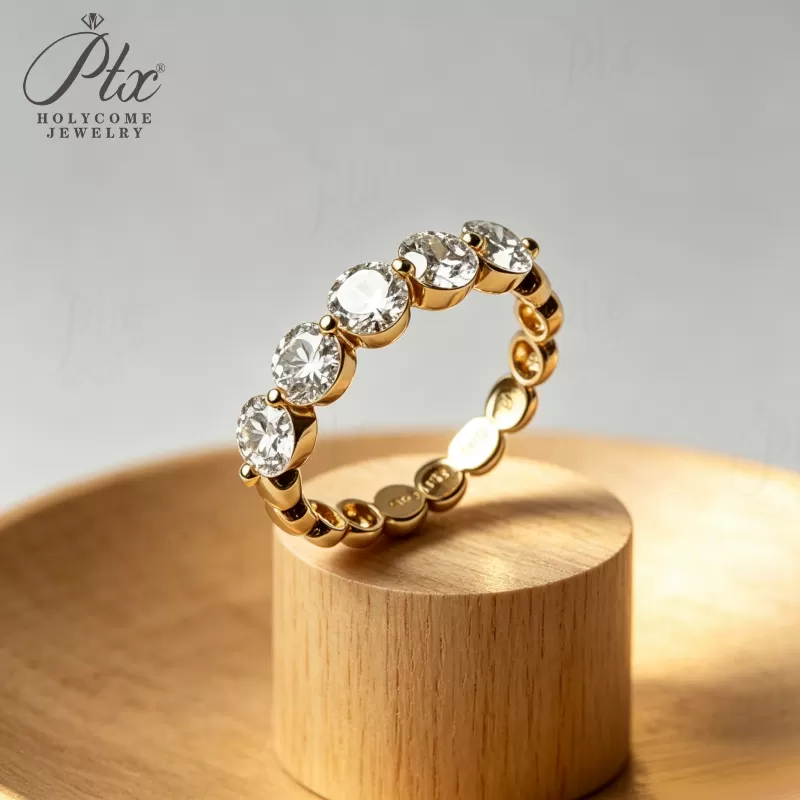
A boutique owner wants her brand logo stamped inside every ring. She finds a supplier that says yes, pays a set-up fee, and receives 100 rings where the logo is a smudge she cannot read even with a loupe. The supplier is not lying. Logo engraving on small silver jewelry has a resolution limit, and the MOQ depends on which method the factory uses. Buying custom silver with a logo is not a yes-or-no question; it is a choice between three methods, each with its own minimum, its own fee and its own smallest readable size.
Hand stamping: the traditional mark
Hand stamping uses a steel die hit by a hammer to press the logo into the inside of a band. It is the method that produces the authentic workshop look, and it works best on flat or gently curved surfaces like the inside of a ring, a tag or a clasp. The realistic MOQ is 100 pieces per design, because cutting the steel die takes a full day and the set-up fee rarely comes down below 40 USD. Hand stamping cannot reproduce fine detail; a logo under 4 mm across will blur into a shape. For the purity stamps that must sit next to your logo, our 925 stamp marks guide shows the legal layout.
Laser engraving: the low-MOQ option
Laser engraving burns the logo into the surface with a focused beam. It works on curved and flat surfaces alike, it handles fine detail down to about 1.5 mm line width, and the MOQ drops to 30 pieces because there is no die to cut. The trade-off is that laser engraving looks machine-made rather than hand-stamped, and it cannot produce the raised relief that hand stamping gives. Laser is the right choice for a small brand testing a private label line. For the broader private label picture, our private label packaging guide pairs the mark with the card and pouch.
Cast-in logo: the bulk-only option
A cast-in logo is sculpted directly into the wax model, so the logo becomes part of the metal itself. It is the method used by large brands at thousands of pieces, and it produces the cleanest result. The MOQ is 300 to 500 pieces per design, because the wax tooling and the mold are expensive. Do not ask for cast-in logo on a 50-piece trial; you will be quoted a price that makes no sense. For buyers comparing engraving against full custom design, our logo engraving MOQ notes lay out the cost step ladder.
The resolution limit every buyer should know
A logo with thin letters, fine lines or a tiny icon will not read at 3 mm, no matter which method you choose. Before you approve the sample, ask the factory to laser-print your logo at actual size on paper and hold it next to the inside of a ring. If you cannot read it on paper, you cannot read it in metal. The ISO 9202 silver fineness standard governs the purity stamp, not the logo, but it sits on the same surface, so leave room for both. For buyers who have already tried stamping and failed, our inside stamping notes cover the common mistakes.
Vector files and the artwork approval step
Whichever method you choose, the factory needs a vector file, not a JPG. A raster logo stretched onto a 4 mm band becomes a blur, and the factory will not warn you; they will engrave what you sent. Ask for a digital proof on the actual product photo before production, and check that the logo orientation sits straight when the ring is on a finger. Allow one to two rounds of proofing; a logo that is crooked on a ring is a brand problem you cannot fix after the piece is sold. The ISO 9202 silver fineness standard does not cover the logo, but the fineness stamp and your logo share the same inner wall, so leave enough surface for both.
What the set-up fee actually buys
A set-up fee sounds like a marketing line item, but it pays for a real tool. Hand stamping pays for a hardened steel die; laser engraving pays for a program and a test run; cast-in pays for a wax tool and a rubber mold. Ask the factory to keep the tool on file for at least two years, so your reorder does not re-incur the fee. If you are also building branded packaging around the mark, our private label packaging guide pairs the engraved mark with the card and pouch so the whole presentation reads as one brand.
What is the minimum order for a logo on silver jewelry?
Laser engraving starts at 30 pieces per design, hand stamping at about 100, cast-in logo at 300 to 500. Choose the method to match your order size, not the other way around.
How small can my logo be?
About 4 mm across for hand stamping, about 2.5 mm for laser engraving. Below that, the logo becomes decoration rather than a readable mark.
Do I pay a die fee every reorder?
For hand stamping and cast-in, no. The die is kept on file and you only pay once. For laser, there is usually no die fee at all, just a per-piece engraving charge.
Can I put my logo on the outside of a ring?
Yes, but outside engraving wears off faster on a ring worn daily. Most brands put the logo inside, and use the outside for the stone or the design.
Designing your first private label mark? HOLYCOME offers laser engraving from 30 pieces, hand stamping from 100, and cast-in tooling from 300, all on 925 silver. Send your logo file and your planned order size, and we will tell you which method will read clearly before you pay any tooling fee.
Frequently Asked Questions
How do I prevent sterling silver from tarnishing in storage?
Use anti-tarnish bags with a sulfur absorber, keep humidity under 60% and avoid paper wrapping. Rhodium plating adds a further barrier on high-turn SKUs.
Is rhodium plating worth the added cost?
Yes for display and gift lines. It resists tarnish for 12–18 months and keeps shelf pieces bright, which reduces markdowns.
What purity do you supply?
925 sterling silver, stamped and hallmarked. Fine silver (.999) is available for beads and bullion-style pieces.
What is the MOQ and lead time?
50 pieces per design, samples 3–5 days, bulk 15–20 days.