How Much Is a 1 Carat Moissanite Ring Really Worth in 2026?
You have probably seen a 1 carat moissanite ring priced at ninety dollars on one website and at nine hundred dollars on another, and the gap makes no sense. Both stones are described as one carat, colorless, and brilliant. So what is a 1 carat moissanite ring actually worth? As a Wuzhou factory that grows and sets these stones every week, we get this question more than any other. The honest answer is that the number on the tag depends on four things almost no product page explains: the grade of the loose stone, the quality of the cut, the metal and setting, and how many middlemen sit between the factory and the customer.
This guide gives you a realistic price range for a 1 carat moissanite ring in 2026, broken down by tier. We will separate what the loose stone costs from what the setting adds, show how color and clarity grade move the price, and explain why the same ring can cost ten times more in a luxury boutique than it does direct from a factory. We also cover what the ring is worth to resale, so you do not confuse the price you pay with the value you can recover. If you are a wholesale buyer, the pricing breakdown at the end is written for your margin math.
One thing to settle up front: carat in moissanite is a misleading label. Moissanite is lighter than diamond, so a 6.5 mm round moissanite, which looks like a 1 carat diamond, weighs only about 0.88 carat. Sellers often call it a 1 carat equivalent stone because of its face-up size, not its weight. When we talk about a 1 carat moissanite ring below, we mean a 6.5 mm center stone that looks comparable to a one-carat diamond. That is the standard trade. Understanding this avoids most price confusion.
The Loose Stone Price: What the 6.5 mm Moissanite Costs
The center stone is the heart of the price. A basic, ungraded 6.5 mm moissanite, cut acceptably but not premium, might cost a factory buyer between eight and fifteen dollars at wholesale. It will look bright, but it may carry a slightly gray or green tone in certain light, and the facets may not be perfectly aligned. This is the stone behind the ninety-dollar rings you see online. It is real moissanite, just not a top-grade one.
A colorless D-F grade, VVS clarity, premium-cut 6.5 mm moissanite with a GRA certificate costs a factory considerably more, typically in the thirty to sixty dollar range at true wholesale. That is the stone that looks genuinely white, returns strong light, and throws the rainbow fire moissanite is known for. To a retail customer it is worth two or three times the basic stone, even though the size on the finger is identical.
The cut grade matters more than customers expect. A poorly cut moissanite leaks light out the bottom and looks dull from the top, no matter how white the color is. A well-cut stone, especially in a round brilliant, returns light to the eye and looks larger and brighter. This is why two stones that both say D color on paper can feel like different products. We explain this tradeoff in our guide to moissanite cuts and shapes.
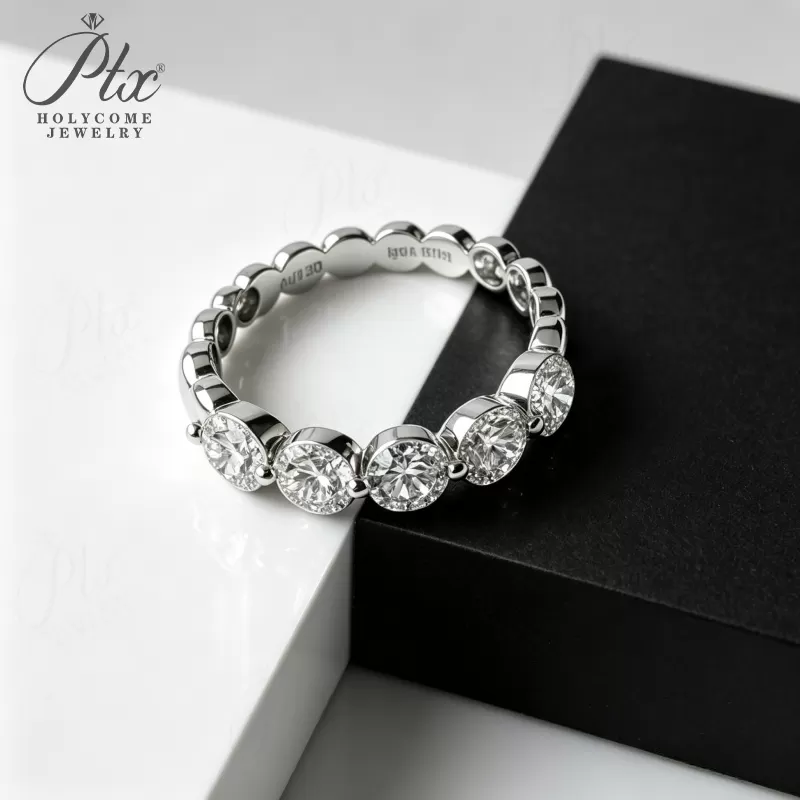
The Setting: How Metal and Design Move the Price
The stone is only half the cost. The ring itself, the band and setting, can be cheaper or more expensive than the stone depending on metal and craftsmanship. A simple sterling silver solitaire setting, machine-made, costs a factory a few dollars to perhaps fifteen dollars. A solid 925 silver setting with hand-finished prongs and a comfort-fit interior costs more. A 10K or 14K gold setting jumps again, and platinum is the most expensive of all.
Design complexity adds cost. A plain solitaire is the cheapest setting. A halo with a border of small stones, a pavé band, a vintage filigree detail, or a six-prong cathedral setting all require more labor. At our Wuzhou workshop, a halo ring takes measurably more assembly and finishing than a solitaire, and that difference shows up in the price. The same 6.5 mm stone in a halo setting can retail for twice what it does in a plain solitaire.
For a customer shopping on a budget, this means the smart move is to choose a premium stone in a simple setting rather than a weak stone in a fancy one. The stone is what people see on the finger. A clean, well-cut center stone in a classic solitaire will look more expensive than a yellowish stone in a heavily decorated setting. For wholesale buyers, we advise stocking a range of setting styles but keeping the center stone grade consistent, so customers can trade up on design without trading down on sparkle.
Realistic Price Tiers for a 1 Carat Moissanite Ring
Putting the stone and setting together, here is what a 1 carat equivalent moissanite ring actually retails for in 2026. These are typical ranges, not quotes, and they assume a sterling silver setting unless noted. The budget tier, around fifty to one hundred fifty dollars, uses a basic ungraded stone and a simple silver band. It looks fine new, but the color may be off and the cut is average. This is the entry online price.
The mid tier, roughly one hundred fifty to four hundred dollars, uses a D-F color, VVS stone with a certificate, in a well-finished silver or plated setting. This is the sweet spot for most retail customers. The ring looks genuinely premium, photographs beautifully, and will stay bright for years. Most of the moissanite rings sold in independent boutiques sit here.
The premium tier, four hundred to one thousand dollars and up, pairs a top-grade stone with a solid gold or platinum setting, a named designer, or a branded presentation. At this level you are paying for the brand, the metal, and the boutique experience, not for a dramatically better stone. We break the factory math down in our article on Wuzhou moissanite wholesale cost advantages.
| Tier | Stone grade | Setting | Typical retail price |
|---|---|---|---|
| Budget | Ungraded, slight gray tone | Basic silver | $50 to $150 |
| Mid | D-F, VVS, certified | Finished silver | $150 to $400 |
| Premium | Top-grade, ideal cut | Gold or platinum | $400 to $1,000+ |
Why the Same Ring Costs Ten Times More in a Boutique
If a factory sells a mid-tier 1 carat moissanite ring for thirty to fifty dollars wholesale, how does it end up selling for four hundred dollars in a mall store? The answer is margin layers. The factory sells to a trading company, which adds a margin. The trading company sells to a distributor, which adds another. The distributor sells to a boutique, which adds its own markup on top of rent, staff, display, and branding. By the time the ring reaches the customer, the original factory price has been multiplied many times over.
This is not a scam. Every business needs to earn a margin, and a boutique offers real services: a fitting room, lighting, staff, a return desk, a warranty, and a trusted brand. But the customer who understands the chain can choose. Buying direct from a factory cuts out the middle layers, which is why a direct-to-customer moissanite ring can sell for a fraction of the boutique price with the same stone.
The key is to verify what you are actually buying. A cheap direct price is only a bargain if the stone is genuinely D-F, VVS, and well cut, with a real certificate. A suspiciously low price is usually a low-grade stone in disguise. When you source direct, ask for the certificate, ask for a real video of the stone in sunlight, and compare the cut. That is the only way to know whether the low price reflects a short supply chain or a short stone. We cover the certificate side in our guide to GRA certification.
Does Color Grade Change the Worth?
Yes, and more than most buyers realize. Moissanite naturally leans slightly toward a warm or gray-green tone, especially in larger stones. A colorless D-F grade has been selected and, in some cases, treated to minimize that tone so it looks as white as a fine diamond. A near-colorless G-H grade will look white in most lighting but may show a faint warmth in bright sun. Customers who are used to diamond color grading pay a premium for the D-F band, and rightly so, because it looks cleaner.
The value difference is real but modest at the factory level. A D-F stone costs a factory perhaps twenty to forty percent more than a G-H stone. At retail, that gap can be stretched further, because customers perceive colorlessness as luxury. For a budget buyer, a well-cut G-H stone offers excellent value. For an engagement ring where the stone will be photographed and compared, the D-F grade is worth the upgrade.
Clarity works the same way. Almost all commercial moissanite is already very clean, because lab growth can be controlled to avoid the inclusions that plague natural diamond. The difference between VVS and SI in moissanite is rarely visible to the naked eye. We explain this in our article on moissanite clarity grades, and our advice to buyers is not to overpay for tiny clarity differences you cannot see. Spend the money on cut and color instead.
What the Ring Is Worth for Resale
Buyers often ask what a 1 carat moissanite ring can be sold for later, and we want to be straight with them. Moissanite holds almost no resale value as an investment. When you resell any jewelry, you recover only a fraction of what you paid, and moissanite is no exception. Because the stone itself is inexpensive and abundant, a used moissanite ring resells for roughly the value of its setting metal plus a small amount, not for the retail price.
This surprises people who expect moissanite to behave like diamond. Diamond has a secondary market and a cartel-supported pricing structure. Moissanite does not. It is a manufactured, affordable, beautiful stone, and its value is in wearing it, not trading it. We go deeper into this in our article on whether moissanite holds value over time. The good news is that because the ring cost so much less than a diamond to begin with, the resale loss is smaller in absolute dollars.
Think of it like buying a good mattress. You do not buy it expecting to resell it. You buy it because you use it every day and it improves your life. A moissanite ring bought for one or two hundred dollars and worn happily for a decade has delivered far more per year than a ten-thousand-dollar diamond that loses half its value the day it leaves the store. Worth, in this sense, is emotional and practical, not financial.
What Wholesale Buyers Should Pay
If you are a boutique buyer or online retailer, the price you should pay for a 1 carat equivalent moissanite ring at wholesale is far below retail. A D-F, VVS, certified stone in a silver solitaire should cost you well under fifty dollars per unit at volume, with per-unit pricing dropping as quantities rise. A halo or pavé setting adds maybe ten to thirty dollars depending on complexity. Gold settings cost more and should be priced by weight and current metal price.
Your job is to balance a price that leaves a healthy retail margin with a stone grade that will not generate returns. Buying the cheapest possible stone maximizes margin on paper but generates complaints when customers notice the gray tone. Buying the top grade minimizes complaints but squeezes margin. Most successful retailers land in the middle: a D-F certified stone in a clean silver setting, sold at a two to three times markup, with clear customer education about moissanite's benefits.
When you source from a factory in Wuzhou, you also gain flexibility on customization. You can ask for specific shapes, your own band widths, personalized engraving, or private labeling. That flexibility is worth more than a few dollars per unit, because it lets you build a brand rather than resell a generic product. We work with retailers on exactly this, and our pricing scales with order quantity.
How Face-Up Size Compares to a Real Diamond
Because moissanite is lighter than diamond, the carat weight label is misleading, and smart buyers shop by millimeter instead. A 6.5 mm round moissanite occupies the same face-up space as a one-carat diamond. From across a room, on a hand held up at a table, no one can tell the difference in size. This is exactly why the 6.5 mm stone is the default choice for anyone who wants the look of a one-carat engagement ring without the diamond budget. When a product says one carat equivalent, this is the measurement it is describing.
If you want a larger look, you can step up to a 7.5 mm or even an 8 mm moissanite and still pay far less than a diamond of the same face-up size. A 7.5 mm moissanite matches the look of a roughly 1.5 carat diamond, and a 8 mm stone approaches a two-carat appearance. At our factory, upsizing the center stone this way adds only a modest amount to the price, because moissanite grows at a controlled cost per millimeter. With a mined diamond, going from one to two carats can quadruple the price. With moissanite, the jump is gentle. That is the core value proposition for buyers who want presence without the cost.
Wholesale buyers should stock the millimeter sizes customers actually ask for. Most bridal customers want the one-carat look first, so the 6.5 mm stone is your volume mover. Keeping a few 7.5 mm stones for customers who want a bolder look lets you upsell without a huge inventory risk. Because the price difference between sizes is small, you can offer the upgrade comfortably and still protect your margin. We always recommend displaying the stones side by side so customers can see the size difference for themselves, rather than choosing from numbers on a screen.
Metal Choices and Their Effect on the Final Price
The metal you choose for the band changes the price almost as much as the stone. Sterling silver is the default for affordable moissanite jewelry. It is durable, takes a bright polish, and can be rhodium-plated to look like white platinum. A silver setting keeps the whole ring in the budget to mid price range, which is why most direct-to-customer moissanite rings ship in 925 silver. It is also the metal we work with most at our Wuzhou workshop.
Solid gold, whether 10K, 14K, or 18K, raises the price in two ways. First, gold costs far more per gram than silver. Second, gold settings are often made to a higher finishing standard because they are sold as fine jewelry. A 14K gold version of the same 6.5 mm solitaire can retail for three to five times the silver version. The stone in the center is identical. The customer is paying for the metal and the fine-jewelry positioning. Platinum sits above gold in price and is the rarest, most premium option.
For most buyers, silver is the practical choice. It delivers the look, the durability, and the sparkle at a price that makes the ring accessible. If you want the warmth of yellow gold without the gold price, gold vermeil, a thick gold layer over silver, is a popular middle ground. The key is to match the metal to how the ring will be worn. A daily silver solitaire is honest, affordable, and beautiful. A gold version is a statement piece. Both can hold the same excellent moissanite. Choose the metal for the life of the ring, not just for the photograph.
Frequently Asked Questions
Is a 1 carat moissanite ring worth buying? Yes, if you want a bright, durable, colorless stone at a fraction of a diamond price. It is worth it for wearing and enjoying, not as a financial investment.
Why do moissanite rings vary so much in price? Because the loose stone grade, the cut, the metal, and the number of middlemen all change. A cheap ring often uses an ungraded stone, while an expensive one uses a certified D-F stone in gold.
Does a 1 carat moissanite look as big as a 1 carat diamond? Yes. A 6.5 mm moissanite is sized to match the face-up look of a 1 carat diamond, even though it weighs less because moissanite is lighter.
Will a moissanite ring hold its value if I resell it? No, not as an investment. Like most jewelry, it resells for a fraction of retail. Its value is in daily enjoyment, and because the original price is low, the absolute loss is small.
Is the GRA certificate worth paying extra for? For bridal or resale-oriented sales, yes. It confirms color and clarity, reduces returns, and lets you sell with confidence. For simple fashion pieces, it matters less.
A 1 carat moissanite ring is worth whatever you are willing to pay for a stone you will love wearing, and the honest price range in 2026 runs from budget online rings under a hundred dollars to premium boutique pieces over a thousand. The difference is almost always the stone grade, the setting, and the markup, not a difference in whether it is real moissanite. Know what grade you are buying, check the cut and certificate, and match the price to the tier.
If you are a retailer seeking factory-direct 1 carat moissanite rings at wholesale prices, or a customer who wants a certified D-F stone without the boutique markup, we are a moissanite and 925 silver manufacturer in Wuzhou, China. Contact service@holycome.com for stock lists, samples, and bulk pricing, and read more on our moissanite value guides to compare prices, cuts, and grades before you buy.