Moissanite Ring Shapes That Restock Fast
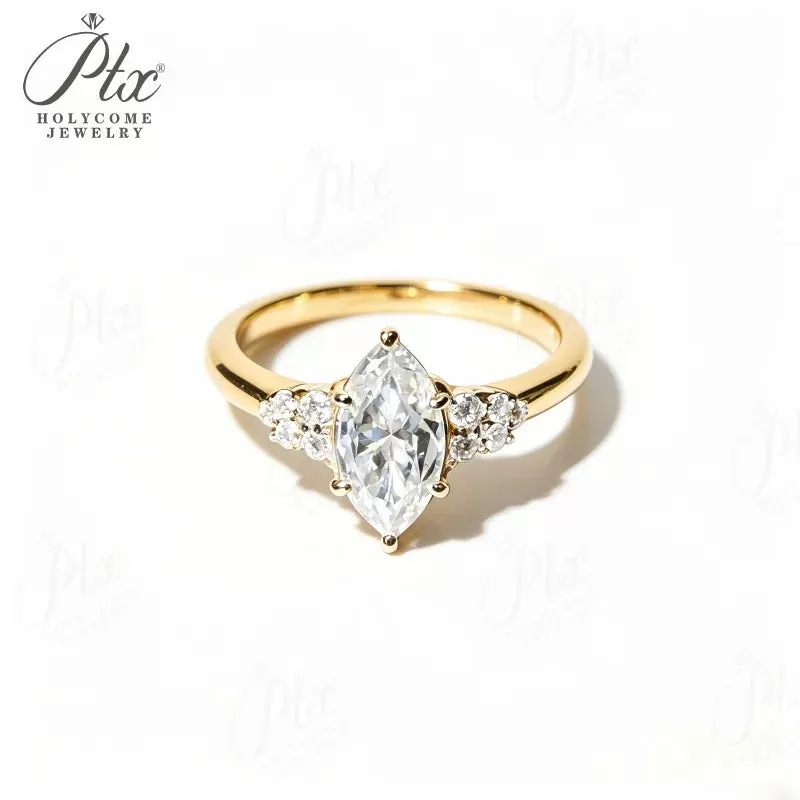
You open three supplier quotes for the same-looking 6.5 mm round moissanite solitaire and the prices differ by almost 60 percent. One quote says 4.80 USD, another 7.20 USD, a third 11.50 USD. The stone looks identical in the photo. If you buy on price alone, you will discover in two months that the cheapest ring tarnished, the center stone tilted, and the card does not match the stone. Wholesale moissanite rings do not sell at one price point. They sit in three tiers, and knowing what you are paying for inside each tier is the difference between a store that reorders and a store stuck with dead stock.
Round: the non-negotiable core
Round brilliant is 55 to 65 percent of most retailers' moissanite ring sell-through, and it is the shape you never under-buy. The 6.5 mm and 8 mm rounds carry bridal, promise and self-purchase demand at once. Stock round in sterling silver and in 10k/14k gold alike; see how the metal choice changes the retail ticket in our karat-versus-silver buying note. Moissanite's refractive index is what makes round look larger than a diamond of the same carat weight; read the gemology on moissanite on Wikipedia.
Oval and cushion: the workhorses behind round
Oval has been the second-fastest mover for three straight years, driven by elongated-finger self-purchase. Stock oval in 8x6 mm and 10x8 mm; the 7x5 mm still moves at the price-driven entry tier. Cushion sits just behind oval because it reads as bridal-soft and photographs well. Together, oval and cushion should take 20 to 25 percent of your ring buy each. Avoid over-buying 5 mm ovals at retail price points above 80 USD - that is the size customers expect a real diamond, and moissanite loses the price argument there.
Pear, emerald and heart: depth that can trap cash
Pear moves at 8 to 12 percent of ring sales in most boutiques, but it skews heavily toward engagement-adjacent buyers who want a matching pendant and earrings. If you already stock pear pendants, add pear rings; if you do not, pear rings alone gather dust. Emerald cut is thinner, at 5 to 8 percent, and sells to a more mature, understated customer. Heart cut is the trap: it looks like a safe Valentine's bet but over-orders badly once February passes. Cap heart at 5 percent of your ring buy. Marquise and asscher are depth SKUs - carry four to six pieces each for the customer who specifically asks, not a block order.
The 100-piece shape grid that protects reorders
For a 100-piece first ring order, Wuzhou volume breaks down to roughly 45 round, 18 oval, 14 cushion, 9 pear, 7 emerald, 4 heart, and 3 each split between marquise and asscher. This keeps 77 percent of cash in the shapes that reorder inside 90 days while still covering the walk-in who asks for something unusual. Pair this grid with the sizing distribution we lay out in ring size stock planning, and match the carat ladder in best-selling moissanite carat sizes. If you are still deciding which shapes pair as a set, read pendant carat stock mix before you commit.
Reading your own sell-through before reordering
The shape grid is a starting point, not a fixed plan. After the first 60 days, count which shapes came back as reorders versus which sat in the tray. Most boutiques find their personal oval share runs higher than the factory average because local taste leans elongated. Reallocate: cut the slowest shape band by half and double the fastest. Do not chase a single hot color or metal finish at the expense of the shape core - a white-glove finish on a heart cut still leaves a heart cut. Keep a simple tally on the reorder sheet and you will know which shapes to deep-stock before the next quarter, rather than guessing from a sample photo.
Which moissanite shape has the best resale turnover?
Round brilliant leads, then oval, then cushion. Together they are 80 percent of most retailers' moissanite ring sales. Buy round deep, oval and cushion medium, and treat every other shape as a small, request-based depth SKU.
Is heart-shaped moissanite a good Valentine's buy?
Only if you order after mid-December to arrive by mid-January, and cap it at 5 percent of ring stock. Over-buying heart is the single most common way retailers end up with dead stock every March.
Do oval and cushion moissanite cost more than round FOB?
Within about 5 to 10 percent at factory level for the same mm size, because cutting irregular shapes has slightly lower yield. The bigger cost is slow turnover, not the unit price.
Should I buy emerald cut if I already sell emerald pendants?
Yes, lightly. Emerald cut rings sell to the same understated customer who already trusts the cut in your necklace tray. Start with 7 to 9 percent of the ring buy and reorder on demand.
Want a shape mix tuned to your reorder rate? HOLYCOME ships loose and set moissanite rings from Wuzhou in every shape above, with stone videos and matching cards. Tell us your best three sellers and your dead stock, and we will rebuild your next 100-piece split so the cash moves instead of sitting.
Frequently Asked Questions
Is moissanite a good diamond alternative for retail buyers?
Yes for price-sensitive customers who want brilliance and hardness. Moissanite ranks 9.25 on the Mohs scale, holds up to daily wear and costs a fraction of a natural diamond of the same size, so it resells fast in bridal and fashion lines.
What is the minimum order for wholesale moissanite?
MOQ starts at 50 pieces per design for stock items. Custom cuts and private-label settings usually start at 100–300 pieces depending on the mold.
Do you provide certificates with moissanite stones?
Yes. Every parcel ships with GRA or IGI documentation listing carat weight, color grade and cut. We recommend passing the certificate to your end customer for trust.
How long does sample and bulk production take?
Samples ship in 3–5 days. Bulk runs take 15–20 days under 500 pieces, and 25–30 days for custom work.