Moissanite Tennis Bracelet Styles
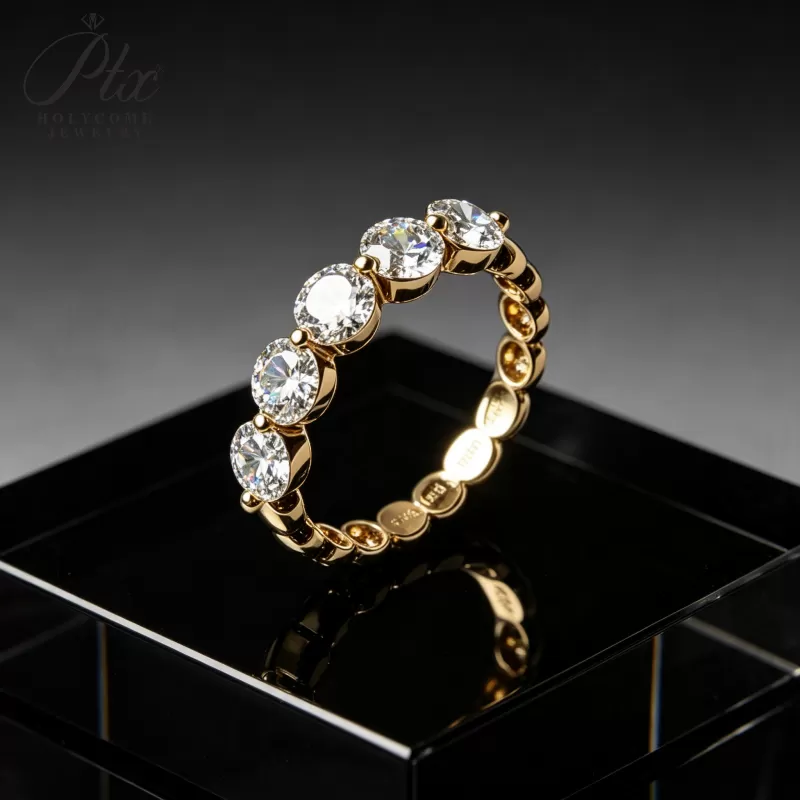
A buyer asks for a moissanite tennis bracelet and the supplier sends a single product photo. That photo shows the classic straight-line row, and most buyers order it. Six weeks later the buyer complains the bracelet rides up on a wrist that is not perfectly straight, the stones twist, and the clasp opens. The problem is not the stone count or the carat weight. It is that tennis bracelets come in at least four silhouettes, and only one of them is the classic straight row. Matching the silhouette to the wrist shape and the customer's lifestyle is what separates a reorder from a return.
The classic straight-line row
The straight-line tennis bracelet is a single row of evenly set stones on a flat flex band. It is the style everyone recognizes from the diamond version, and it sells about 55 percent of the moissanite tennis bracelets we ship. It looks clean on a slim wrist with a straight bone structure. On a curved wrist, the band lifts away from the skin on the inside, the stones twist, and the clasp bears the load alone. The 3 mm to 4 mm stone spacing is the workhorse; for the width breakdown, our 2 mm to 5 mm width guide shows where each size sits in price.
The curved and contoured row
The curved tennis bracelet is pre-bent to follow the inside of the wrist, so the stones sit flat against the skin even on a curved wrist. It costs about 8 percent more to produce because the band must be formed by hand, and it is the style that bridal buyers should ask for by default. Curved rows sell best in the 5.5 to 6.5 inch wrist range, which is the average women's wrist. If your bridal buyer says the straight row twists on her, she needs the curved version, not a smaller stone. The moissanite stone is identical across both silhouettes; only the band geometry changes.
The flex and half-eternity hybrids
A flex bracelet uses a woven band that bends in two directions, so it fits a wider range of wrists without resizing. It is the sport-luxury style, popular with buyers who want a tennis bracelet they can wear while typing or cooking. Flex bracelets sit at about 15 percent of our tennis sales. Half-eternity means the stones cover only the top half of the wrist, leaving the underside of the band plain; this sells to brides who want the look without the cost of a full row, and it pairs neatly with an engagement ring. For demand on stone sizes across these hybrids, our stone size demand guide tracks the 3 mm to 5 mm split.
Wrist size and clasp: the two specs buyers forget
A tennis bracelet that does not fit returns, regardless of silhouette. Stock 6.0 inch as the default women's size, 6.5 inch as the large, and offer a 1-inch extension chain as a free add-on. The clasp must be a box clasp with a figure-8 safety, not a lobster claw, because the lobster opens under lateral pressure. A double safety clasp is worth the extra 0.60 USD per piece. For buyers who also stack wedding bands, our wedding band width grid coordinates the look.
The single-stone versus pavé debate
Within the tennis category there is a second split buyers miss: a tennis bracelet uses individually set stones, while a pavé or illusion bracelet glues or grains small stones onto a flat band. The tennis version is the one customers mean when they say tennis bracelet, and it commands 20 to 30 percent more at retail because each stone is set by hand. The pavé version looks similar in a product photo but loses stones faster and returns more often. If a quote comes in suspiciously low for a tennis bracelet, ask whether the stones are prong-set or pavé-set before you assume it is the same product. The moissanite stone is identical; the setting method is what separates the two prices.
Seasonal demand you should plan around
Tennis bracelets sell in two waves. The first is April to June, driven by bridal and Mother's Day gifting. The second is November to December, driven by holiday and office gift budgets. Orders placed in February and March arrive just in time for the bridal wave, and orders placed in September arrive for the holiday wave. Buying out of season means you pay the same FOB price but sit on the stock for six months. Coordinate the bracelet buy with the ring buy using our wedding band width grid so your bridal floor reads as one collection rather than scattered pieces.
Which tennis bracelet style sells best?
The classic straight row still leads at about 55 percent of orders, but the curved row is growing faster as bridal buyers learn the difference. Stock 60 percent straight, 30 percent curved, 10 percent flex or half-eternity.
What wrist size should I order as default?
6.0 inch for women's stock, with a 1-inch extension. The extension converts a 6.0 inch bracelet into a 6.5 inch fit without holding two sizes in inventory.
Can I resize a tennis bracelet after delivery?
Only by removing or adding links at the clasp end. A curved or flex band cannot be re-bent by a local jeweler without risking the stone settings, so spec the size correctly at order.
Is a 2 mm tennis bracelet too thin?
For everyday wear, yes. A 2 mm row reads as a child's bracelet and is easy to miss on the wrist. 3 mm is the minimum retail-safe size, with 4 mm as the luxury sweet spot.
Building a tennis bracelet line? HOLYCOME ships straight, curved, flex and half-eternity moissanite tennis bracelets in 925 silver rhodium, with box-and-figure-8 clasps and a 30-piece MOQ per style. Send your wrist-size mix and we will quote the silhouette split for your market.
Frequently Asked Questions
Is moissanite a good diamond alternative for retail buyers?
Yes for price-sensitive customers who want brilliance and hardness. Moissanite ranks 9.25 on the Mohs scale, holds up to daily wear and costs a fraction of a natural diamond of the same size, so it resells fast in bridal and fashion lines.
What is the minimum order for wholesale moissanite?
MOQ starts at 50 pieces per design for stock items. Custom cuts and private-label settings usually start at 100–300 pieces depending on the mold.
Do you provide certificates with moissanite stones?
Yes. Every parcel ships with GRA or IGI documentation listing carat weight, color grade and cut. We recommend passing the certificate to your end customer for trust.
How long does sample and bulk production take?
Samples ship in 3–5 days. Bulk runs take 15–20 days under 500 pieces, and 25–30 days for custom work.