Half Ring Sizes: Why They Matter and When You Can Resize Later
Why does a 0.5 size difference even exist? If a ring comes in a 7 and an 8, surely a 7.5 is just marketing, right? It is not. The half size is one of the most important numbers in the whole sizing system, and ignoring it is the reason a surprising number of otherwise beautiful rings end up in a drawer. A half size is about 1.3 millimeters of extra circumference, which sounds tiny until you try to wear a band that digs into your finger by that exact margin. We make rings in Hengang, Longgang, Shenzhen, and we build every band in half steps on purpose, because the customers who ask for a half size are almost always the ones who wear the ring every single day. This guide explains what half sizes actually mean, when they are worth paying attention to, and when you can safely skip them and just resize the ring later.
The core idea is that human fingers do not come in whole-number increments. They come in every possible millimeter. Some people are a size 7. Some are a 7.4. Some are a 7.6. The whole-size system pretends those people are all a 7 or an 8, and the half-size system admits that they are not. If you force a 7.4 person into a 7, the ring is a little tight and they take it off after an hour. If you force them into an 8, it spins around and they worry about losing it. The 7.5 is the compromise that lets them forget they are wearing jewelry at all, which is the whole point of a comfortable everyday ring. You can read the basics of how sizes are measured in our size guide, but the half size is where the practical detail lives.
There is also a commercial reason half sizes matter, especially for retailers. A store that stocks only whole sizes turns away the large group of customers who live between them. That group is not a small edge case. Industry experience suggests nearly half of ring buyers sit on a half size rather than a whole size. If your store has 6, 7, 8, and 9 but not 6.5, 7.5, and 8.5, you are asking almost half your walk-in traffic to either compromise or leave. We build our wholesale bands in half steps precisely so our retail partners do not have to make that compromise, and we discuss the stocking logic in our value guides.
What a Half Size Actually Changes on the Finger
A half size is roughly 1.3 millimeters of circumference, which translates to about 0.4 millimeters of inner diameter. To picture that, it is thinner than a human hair in diameter terms, but the effect on comfort is out of proportion to the number. Rings sit on a finger that is slightly compressed by the band, and that compression means even a small change in inner radius changes how the band feels. A ring that is 0.4 millimeters too small presses into the flesh just enough to leave a faint mark and to feel tight when the finger swells. A ring that is 0.4 millimeters too large rotates a little more than it should and catches on gloves.
This is why two rings labeled the same whole size can feel different. One might be a true 7, measured to 54.4 millimeters. Another might be a 7.5 labeled as a 7 because the factory only made whole sizes, and it will feel loose on a true 7 finger. When you buy from a maker who lists half sizes honestly, the number means something. When you buy from a generic catalog that rounds everything to the nearest whole, the number is a guess. The honest half-size listing is worth a little more money, because it removes the guesswork. We stamp our bands with the size and measure the inner diameter on a mandrel before they ship, so the half size you order is the half size you receive.
The half size also interacts with band width. A half size matters more on a wide band than a thin one. On a two-millimeter thin band, a half size of slack is barely noticeable. On a six-millimeter comfort band, that same half size is the difference between a snug everyday ring and a loose one. This is why we always recommend half-size precision for wide men's bands and signet rings, and say that thin solitaire bands can get away with a little more rounding. If you are buying a thin dainty band and you are between sizes, choose the larger whole size without guilt. If you are buying a wide band, get the half size right. You can read more about how width changes fit in our guide to band fit and metal choices.
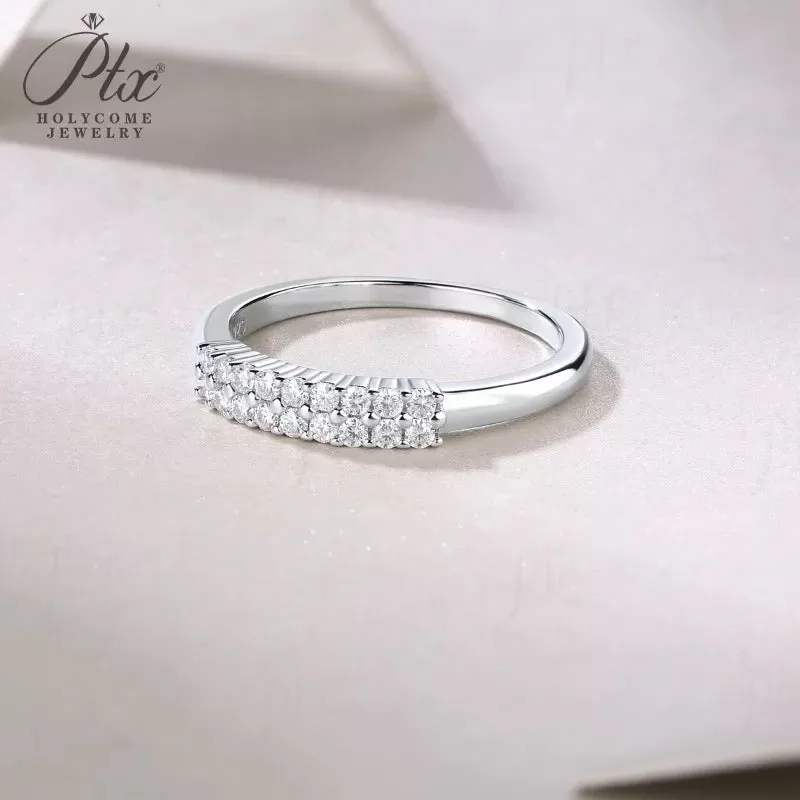
When You Should Buy the Exact Half Size
There are four situations where the half size is non-negotiable. The first is an engagement or wedding ring, which will be worn for decades and never taken off. A ring you wear every day for years must fit precisely, because a band that digs in will become a source of irritation, and a band that spins will become a lost ring. Spend the effort to measure the exact half size for any ring that is meant to be permanent. The second is a ring with stones set all the way around the band, called an eternity ring. These cannot be resized later without removing and resetting stones, so you have to get the size right the first time.
The third situation is a wide band over five millimeters. As we discussed, width amplifies the effect of a size error, so a wide band in the wrong half size is noticeably uncomfortable. The fourth is a ring bought for a surprise gift, where you cannot try it on and then return it easily. For a surprise, you want the most precise measurement you can get, because you will not be there when it is first worn. Measure an existing ring from that person's jewelry box, take the inside diameter, and order the nearest half size. If you are unsure between two half sizes, choose the larger one, because it is the safer mistake. We explain the surprise-gift measuring trick in our home measuring guide, and it relies entirely on having honest half sizes to choose from.
There is also a durability angle. A ring that is too tight puts constant pressure on the shank, and over years of wear the metal can deform, especially in softer materials like 925 silver. A band that is slightly too loose has room to expand with the finger and stays round. So the half size is not only about comfort. It is about how long the ring keeps its shape. We see this in our repair returns: the bands that come back bent are almost always the ones that were a half size too small, worn tight for years. The bands that came back resized down are the ones that were too loose. Either way, getting the half size right the first time avoids the trip to the jeweler.
When You Can Skip the Half Size and Resize Later
Not every ring needs perfect half-size precision. A thin fashion band, under three millimeters wide, can usually be resized easily after the fact, because it has a plain shank with no stones and plenty of metal to work with. If you are buying a thin silver stacking ring and you are not sure between a 6.5 and a 7, buy the 7 and have it resized down if it is loose. A local jeweler can adjust a plain thin band for a modest fee in a few days. The cost and the wait are worth it because the band is simple, and the resizing will not damage anything.
The second case is a ring you will wear occasionally rather than daily. A statement ring, a cocktail ring, or a piece for special occasions can tolerate a half size of slack, because you are not wearing it through a full day of typing, washing dishes, and typing. A fashion ring that is a touch loose is fine for an evening out. The third case is when you are buying a low-cost piece and want to try the style before investing in the perfect fit. In that situation, buy the whole size, wear it, and if you love the style, come back for the precise half-size version in the better material. We encourage this with our sample program, and you can read about how we price samples in our wholesale value notes.
The key distinction is whether the ring can be resized at all. Plain bands without stones can be resized up or down by about two sizes, usually. Rings with stones on the top half of the band can be resized down by about one size, carefully. Rings with stones all the way around, or rings made in certain hard-to-work metals, cannot be resized at all. If the ring you are buying cannot be resized, get the half size right the first time. If it is a plain band that can be resized freely, you have more room to experiment. This is the decision tree we walk every customer through, and it removes most of the anxiety around ordering a ring online.
How Resizing Actually Works, and Its Limits
Resizing a plain band is a small, old-fashioned operation. The jeweler cuts the shank with a tiny saw, removes a small wedge for making the ring smaller, or adds a small piece of matching metal for making it larger, then solders the joint, smooths it, and polishes it. Done well, the joint is invisible. Done poorly, you can see a line or feel a ridge. A plain 925 silver band resizes easily because silver is soft and solders cleanly. A platinum or titanium band is harder to resize, and a tungsten band cannot be resized at all because the metal is too brittle. The material matters as much as the size.
There are limits. A ring should not be resized up or down by more than about two sizes, because stretching or compressing the band beyond that distorts its shape and stresses the metal. If you need to go more than two sizes, the ring usually needs to be remade rather than resized. Resizing also weakens the shank slightly at the joint, so a ring should not be resized repeatedly. One resize is fine. Two resizes is asking the joint to hold twice. Three resizes and the band is living on borrowed time. This is another reason to get the half size right the first time: every resize is a small tax on the ring's future strength.
If the ring has stones, the resizing becomes more delicate. Heat from the soldering can damage heat-sensitive stones, so the jeweler may need to remove stones near the joint, or use a laser welder that applies less heat. Moissanite and 925 silver settings handle this well, but stones set in prongs need to be checked after resizing, and the prongs can become slightly loose. We recommend that any resized ring with stones be re-checked by a jeweler within a month of wearing, just to confirm the prongs are still snug. We talk about the durability of the stones themselves in our article on moissanite clarity and wear, and the same care applies after a resize.
| Ring Type | Resizable? | Get Half Size Right? |
|---|---|---|
| Plain thin silver band | Easily, up to ~2 sizes | Not critical |
| Wide comfort band | Yes, carefully | Yes, width amplifies fit |
| Engagement solitaire | Yes, one size | Yes, worn daily |
| Half-eternity band | Limited, one size | Yes |
| Full eternity band | Rarely, usually remade | Absolutely |
| Tungsten or ceramic | No | Absolutely |
Sizing Guards: The Cheap Fix Before You Resize
If your ring is a half size too large and you are not ready to resize it, a sizing guard is the simplest fix. A sizing guard is a small strip of metal or clear plastic that clips or glues to the inside of the band, taking up the extra space so the ring does not spin. They cost almost nothing, they are reversible, and they work well for a ring that is loose by up to a full size. Jewelers sell them, and you can buy them online in packs. For a ring that is a half size too big, a guard is often the better choice over a formal resize, because it is free, reversible, and does not put heat near any stones.
Guards have a few drawbacks. They add a small bump on the inside of the band, which some people feel against the finger. They can collect a little soap and lotion. They can fall off if they are the clip-on type and not checked. But for an everyday ring that spins, a guard solves the problem overnight, and it buys you time to decide whether you actually want a permanent resize. We tell our retail customers to keep a few guards in a drawer, because they are the first thing to try when a customer says a ring is loose. For a related small-adjustment topic, see our guide to wrist fit and small adjustments, where the same reversible logic applies.
If a guard makes the ring comfortable, you may never need the resize. Many people wear guarded rings for years without issue. The guard is especially useful when the ring occasionally fits fine and occasionally feels loose, because the finger fluctuates. A resize commits you to one size. A guard lets the ring flex with the day. This is why we see guards recommended for engagement rings that fit in winter but feel loose in summer. The ring stays the size it is, and the guard handles the seasonal swing. For a permanent everyday band, though, the cleanest long-term answer is still the correct half size, measured once and worn for years.
Why We Build Every Band in Half Steps
A lot of factories save cost by pressing only whole sizes. It is fewer molds, fewer SKUs, simpler inventory, and the customers who cannot find their half size simply compromise. We chose the opposite. Every band we ship comes in half steps from size 5 to size 12 for women and 9 to 13 for men, because we have seen what happens when a store cannot offer the half size. The customer leaves, buys nothing, and remembers the store as the one that did not have their size. A half-size range is not a luxury; it is the difference between a sale and a walk-out.
Building in half steps costs us more in tooling and inventory, but it pays back in fewer returns and happier repeat customers. A ring that fits the first time is a ring the customer wears every day, sees every day, and eventually comes back to buy more from us. A ring that comes back for a resize is a ring that takes weeks, generates frustration, and risks the relationship. When we send a wholesale sample to a boutique, we include the half sizes alongside the wholes, so the boutique can let customers try on 7 and 7.5 side by side and feel the difference. That side-by-side try-on sells the ring faster than any description, because the customer feels the fit on their own finger.
For a retailer, stocking half sizes is also a margin move. A customer who finds their exact half size in your store is less price-sensitive, because they cannot easily find that size elsewhere. The half size becomes a reason to buy from you specifically, not from the discounter who only stocks whole sizes. We help our wholesale partners build this half-size range into their assortment, and we discuss the stocking economics in our value guides. The point is not that half sizes are some premium feature. It is that they are the basic price of a good fit, and a good fit is what turns a one-time buyer into a regular customer.
Measuring for the Exact Half Size
If you want the precise half size, the at-home method needs to be a little more careful. Measure the finger circumference three times, as we describe in our home measuring guide, and write down the three millimeter numbers. If they cluster around 55.6 millimeters, you are a 7.5. If they cluster around 54.4, you are a 7. If they scatter between 54.8 and 56.0, take the average and round to the nearest half size. The key is to measure on a normal day, at midday, with clean dry hands, and not to overthink a single outlier reading. The average of three careful measurements is more reliable than any one of them.
If you are between two half sizes, use the band width to decide. For a thin band, round up to the larger half size. For a wide band, round up to the larger half size as well, because wide bands feel snug. For a comfort-fit rounded-inner band, you can round to the exact measurement without compensation. If your knuckle is large, measure the knuckle circumference and choose the half size that passes over it with a little resistance, accepting a slight looseness at the base. If you are still unsure, order the larger half size and add a sizing guard rather than a resize. You will end up with a ring that stays on and feels right, which is the whole goal.
The honest truth is that the half size is not a complicated concept. It is just the admission that fingers come in between whole numbers, and a ring that respects that detail fits like it was made for you. Whole sizes are a convenience for factories. Half sizes are a courtesy for the person wearing the ring. When you have a choice, choose the half size. When you cannot, choose the larger size and fix the slack with a guard or a small resize. Either way, the ring ends up on your finger comfortably, which is what both the factory and the customer actually want.
Frequently Asked Questions
Is a half size really that different? Yes, about 1.3 millimeters of circumference, which is enough to change whether a ring digs in or spins. On a wide band the difference is more noticeable.
Can a jeweler make my ring a half size smaller? Yes, a plain band can be resized down by a half size easily. A ring with stones all around is harder and may need remaking.
Should I buy a whole size and resize, or the exact half size? For plain thin bands, buying a whole size and resizing is fine. for eternity, wide, or surprise rings, buy the exact half size.
What if I am between two half sizes? Choose the larger one. A ring that is a touch loose is safe; one that is too tight will not go on.
Does resizing ruin the ring? Done once by a skilled jeweler, no. Repeated resizing weakens the shank, which is why getting the size right the first time matters.
Half ring sizes exist because fingers are not whole numbers. A 0.5 size is roughly 1.3 millimeters of extra room, and on a wide band or a daily-wear ring that margin is the difference between a ring you forget you are wearing and one you take off by lunch. Buy the exact half size for engagement rings, eternity bands, wide bands, and surprise gifts. For plain thin fashion bands, you can buy the whole size and resize later, or use a cheap sizing guard to take up the slack. Either way, the goal is a ring that stays on and feels right.
We are a jewelry maker in Hengang, Longgang, Shenzhen, and every silver and moissanite band we ship is available in half steps from size 5 to 13. If you want our half-size stocking chart for your store, or a free sizer to measure your own finger, email service@holycome.com and we will send it with our latest band pricing. You can also explore our size guide library and read about why 925 silver is the everyday metal we work in.