Lab-Grown Diamond Color Consistency Wholesale
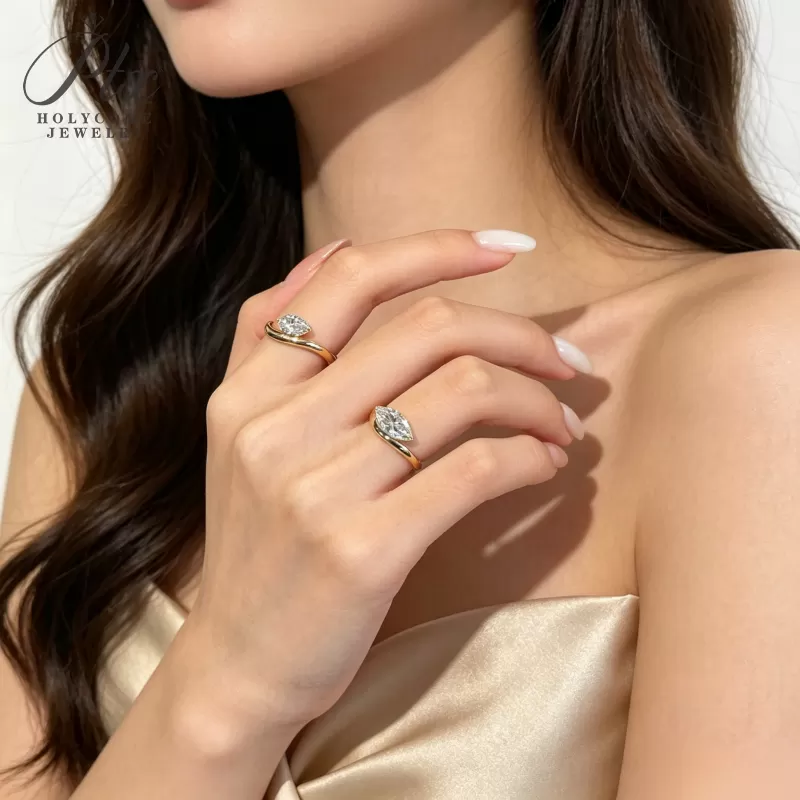
Lab-grown diamond stock sounds like a solved problem: same chemistry, same grading, same price movement. In practice, the most common complaint from retailers who buy in bulk is not price, not clarity, not the certificate. It is color. A pair of studs that looked matched under a factory light will split into one cool white and one slightly yellow under a store's warm spotlights. The customer returns the pair, the retailer blames the supplier, and the supplier says both stones are graded "G". The gap between "G" on a certificate and "G" in real lighting is the topic of this guide.
Why lab-grown color varies even within one grade
Lab-grown diamonds are grown by either CVD (chemical vapor deposition) or HPHT (high pressure, high temperature). Both methods introduce trace nitrogen that shifts the body color. A stone graded "G" by IGI sits in a band, not a point: G runs from the top of F to the bottom of H. Two stones both labeled "G" can sit at opposite ends of that band. On a single solitaire no one notices. On a pair of studs, a tennis bracelet, or a row of pendants, the eye compares side by side and the band becomes visible. The lab-grown diamond entry on Wikipedia describes the growth methods; the buying takeaway is that color grading is a range, and range is what you are really purchasing.
What color grade to stock for bulk
For studs, pendants and everyday jewelry, the D-E-F colorless band is the tier that reads "bright white" under any lighting. The G-H near-colorless band is the value tier: under daylight they look white, under warm store light they pick up a slight yellow tint. For a bulk order, stock the volume SKUs in D-E-F and reserve G-H for price-point pieces where the customer expects a deal. If you sell a "colorless" claim in your marketing, stick to D-E-F; the FTC's Jewelry Guides require that lab-grown diamonds be disclosed as lab-grown, and a "white" claim that relies on G-H stones risks a return complaint.
The "matched pair" requirement: ask for it on the PO
When you order studs in bulk, the factory can either pair stones randomly or pair them by growth run and color sub-grade. Random pairing gives you the split-color problem. Matched pairing costs a small delta (often $1 to $3 per pair) but is the line item that prevents returns. On the PO, specify: "matched pair, same growth run, within one color sub-grade (e.g., top-of-G matched to top-of-G)." For tennis bracelets, the run requirement is stricter: ask for the whole row from one growth lot, because a row of ten stones from mixed lots will show a visible gradient along the wrist. We cover the stone side of grading in lab-grown diamond wholesale with IGI papers, and the moissanite alternative for price-point stock in moissanite stud pricing by size.
For retailers who want the same matched-pair discipline at a lower ticket, our moissanite stud pricing guide uses the same growth-run matching on silicon carbide, where color drift shows up just as clearly.
Fluorescence: the detail that shows up under UV
Some lab-grown diamonds carry blue fluorescence that is invisible in daylight but glows under UV light (store black lights, nightclub lighting). It is not a defect, but it is a consistency risk: one stone in a pair with strong fluorescence and one without will read differently under UV. Ask the factory for the fluorescence grade on matched pairs. Most buyers accept medium blue fluorescence on solitaires but prefer none-to-faint on pairs and rows.
Clarity cut and the price ladder
Bulk lab-grown jewelry is usually stocked in VS-SI clarity, where inclusions are not visible to the naked eye. Higher clarity (VVS) adds cost without a retail premium most customers will pay. Cut grade is where you should not skimp: a "good" cut lab-grown diamond looks dull next to an "excellent" cut of the same color, and the eye catches that faster than it catches a G vs H difference. Insist on Excellent or Very Good cut on the volume SKUs.
Frequently asked questions
Why do my lab-grown studs look mismatched?
Usually because the two stones came from different growth runs and sit at opposite ends of the same color band. Specify matched pairs from the same run on the PO.
What color grade is "white enough" for retail?
D-E-F reads colorless under any lighting. G-H reads white in daylight but picks up warmth under warm spotlights. Use G-H only for price-point pieces.
Does fluorescence matter on bulk lab-grown jewelry?
On solitaires it is cosmetic. On pairs and rows, mismatched fluorescence shows under UV lighting. Ask for none-to-faint on matched pairs.
Should I buy IGI or GIA graded lab diamonds for bulk?
IGI is the standard for lab-grown wholesale and is accepted by most retailers. GIA graded lab diamonds are available at a premium and are worth it for high-ticket solitaires.
We supply matched-pair and single-stone lab-grown diamond jewelry in D-E-F and G-H, with IGI grading sheets and fluorescence specified per SKU. Send your color-and-matched-pair requirements and we quote per lot.