Lab Grown Diamond Studs Matched Pairs
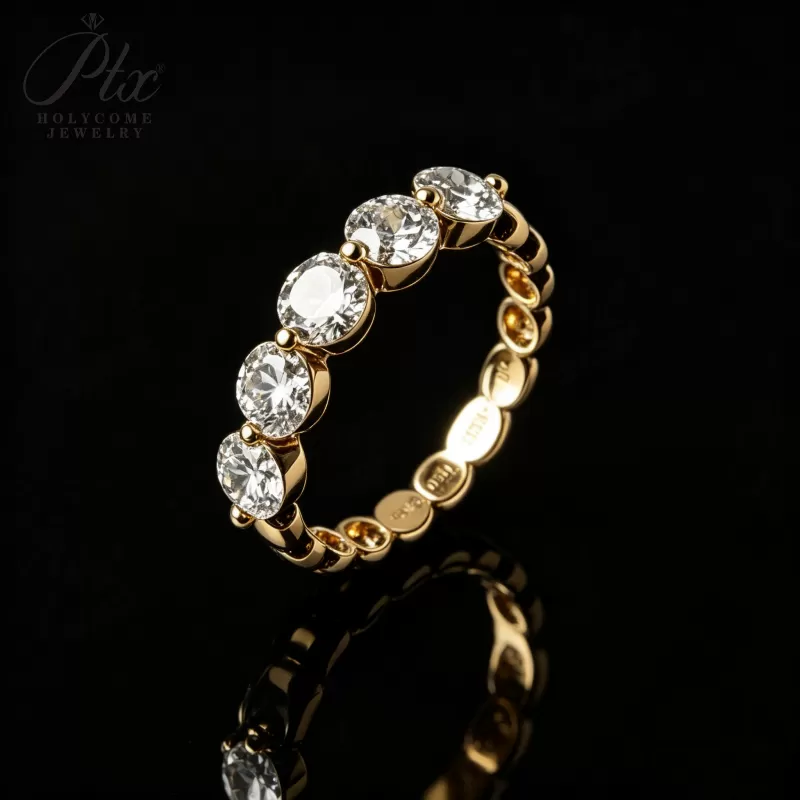
A pair of lab-grown diamond studs arrives from the factory. You hold them side by side under the store light, and one stone looks whiter than the other. The customer at the counter notices too, and suddenly the $249 sale turns into a return conversation. Mismatched pairs are the single biggest quality complaint on lab-grown diamond studs, and they are almost always a buying-side problem, not a factory defect.
What matching actually means for stud pairs
When a customer buys a pair of studs, the two stones are worn on opposite ears, 15 centimeters apart, usually outdoors or under warm retail light. The eye cannot tell a D from an F at that distance, but it can tell a VS1 from an SI2 if the customer leans into a mirror. Matching means three things held equal across the pair: color within one grade, clarity within one grade, and cut proportions within 10 percent. The GIA 4Cs framework gives you the language; the factory gives you the actual stones. A pair that is both G VS1 will sell cleanly at $249. A pair that is one G and one H, both VS1, will also sell cleanly. A pair that is one VS1 and one SI2 with visible black inclusions will not.
How Wuzhou factories pair stones
Factories that supply stud pairs use two systems. The cheaper system is loose-stone picking, where two stones are pulled from a bulk parcel that is graded G-H VS-SI as a group. The price is lower, but the matching is luck. The better system is lab-grown diamond pairing, where the factory sorts a parcel by exact color and clarity grade, then hand-picks stones that match within half a grade. The paired system costs about 15-20 percent more FOB, but it cuts stud returns by more than half. Read our note on lab-grown diamond stud matched color pairs before approving a bulk parcel. We also cover certificate bundling in lab-grown diamond wholesale certificate bundles.
Which sizes carry the highest mismatch risk
Mismatch risk climbs fast above 5 mm. At 4 mm and below, the stones are small enough that the human eye cannot resolve color difference. At 5-6 mm, the G to H difference becomes visible in daylight. At 7 mm and above, even a one-grade clarity difference shows up as a visible inclusion on one ear. If you are stocking studs above 6.5 mm, insist on a paired lot and ask the factory to send a side-by-side lightbox video before bulk shipment. Compare sizes with moissanite stud earring sizes 3-8 mm.
What to write on the PO
Ask the factory for: matched pairs, not a random parcel; color grade within one grade across the pair; clarity within one grade; and a GRA or IGI card per stone. If the factory cannot provide per-stone certificates at your MOQ, at minimum require a paired-stone sheet that lists both stones on one card. Buyers who skip this clause end up sorting stones themselves at the store, which is not a good use of staff time.
Earring backs are the forgotten half of a stud order. Butterfly backs are the default and cost the least, but they come loose during the day. Screw-back backs stay on but are harder for customers to put in. Friction backs sit in the middle. Above 0.5 carat per stone, most retailers switch to screw-backs because the investment justifies the security. Ask the factory which back is included in the price; upgrading to screw-backs adds about $0.30 per pair FOB.
Do lab-grown diamonds need to be perfectly color-matched?
No. Within one color grade, say G and H, the eye cannot tell the difference at ear distance. The return problem starts when the pair spans two or more grades, for example one F and one J.
What clarity grade should I stock for everyday studs?
VS2 to SI1 is the sweet spot. VS1 is brighter but costs more; SI2 starts to show visible inclusions at 6 mm and up. Most everyday stud buyers cannot see SI1 inclusions without a loupe.
Should studs come with a certificate per stone?
Above 0.5 carat total weight per pair, yes. Below that, a paired card is enough. Certificates add about $3 per stone to the FOB and are worth it on 1 ct and larger pairs.
Can I exchange mismatched pairs with the factory?
Only if it is in the PO. Most Wuzhou factories accept a 5 percent mismatch replacement allowance on stud orders, but you have to ask in writing before the order ships.
Ordering lab-grown diamond studs? HOLYCOME supplies hand-paired lab-grown diamond stud pairs from 3 mm to 8 mm in 925 silver, 10K and 14K mounts, with per-stone GRA/IGI options. Send your target size and color grade and we will quote a matched lot within 24 hours.
Frequently Asked Questions
Is moissanite a good diamond alternative for retail buyers?
Yes for price-sensitive customers who want brilliance and hardness. Moissanite ranks 9.25 on the Mohs scale, holds up to daily wear and costs a fraction of a natural diamond of the same size, so it resells fast in bridal and fashion lines.
What is the minimum order for wholesale moissanite?
MOQ starts at 50 pieces per design for stock items. Custom cuts and private-label settings usually start at 100–300 pieces depending on the mold.
Do you provide certificates with moissanite stones?
Yes. Every parcel ships with GRA or IGI documentation listing carat weight, color grade and cut. We recommend passing the certificate to your end customer for trust.
How long does sample and bulk production take?
Samples ship in 3–5 days. Bulk runs take 15–20 days under 500 pieces, and 25–30 days for custom work.