Moissanite Pendant Bail Options Guide
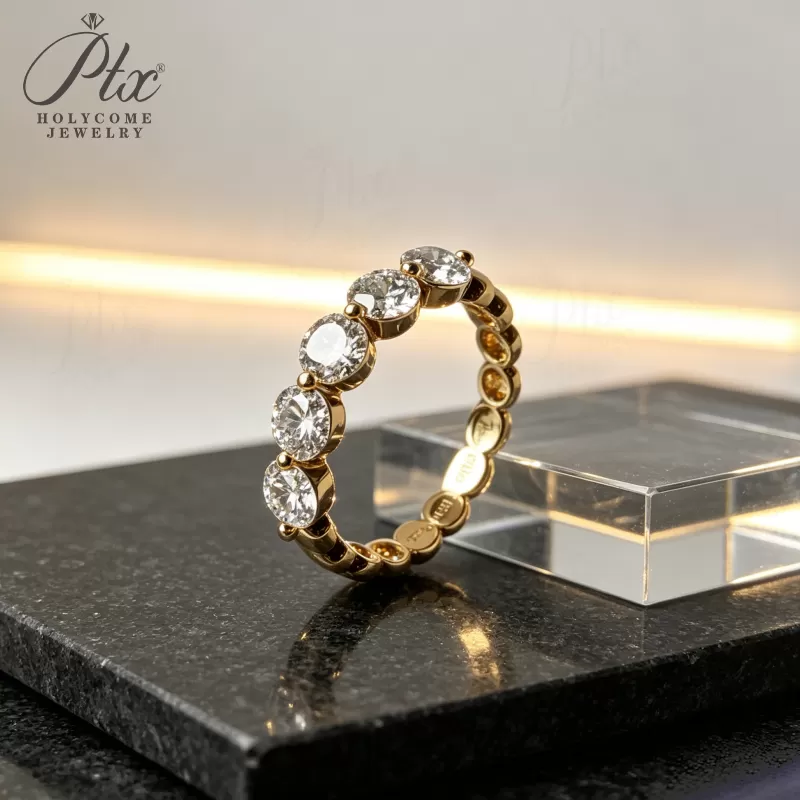
The pendant is on your website. The stone is white, the chain is dainty, and yet returns are running at 14 percent instead of the expected 5 percent. Before you blame the photo, check the bail. The bail is the small loop that joins the pendant to the chain, and it is the part of a moissanite pendant buyers forget to ask about until a customer complains the pendant flips over on the neck.
The four bail types buyers see in Wuzhou catalogs
Factory catalogs list four bail constructions. The first is the fixed closed bail, a soldered loop sized for a 1.2-1.5 mm chain. It is the cheapest to make, the most secure, and the reason customers complain the pendant will not thread onto a thicker cable chain. The second is the open spring bail, a hinged loop that clicks open and lets the buyer swap chains freely. Open spring bails add about $0.60 to $1.20 to the FOB cost but cut pendant-on-chain returns sharply. The third is the swivel bail, which rotates 360 degrees so the pendant always faces forward. Swivel bails are common on heart and teardrop pendants. The fourth is the hidden bail, tucked behind the stone so only the chain shows. Hidden bails look the cleanest in product photos but are the most fragile and the hardest to repair. The IGI grading reports that ship with many Wuzhou moissanite pendants cover the stone, not the bail, so bail quality is on the buyer to inspect.
Which bail pairs with which chain
A fixed bail with a 3 mm inner width works with box, cable and snake chains up to 1.5 mm. If your store sells 2 mm Figaro or curb chains, you need an open bail with a 4-5 mm inner width. Swivel bails work best on 1-1.2 mm dainty chains, because the swivel joint is slightly bulkier and looks wrong on heavy chains. Before you mix pendant and chain SKUs, read our guide on silver necklace chain gauge and weight to make sure the bail opening clears the chain end. We also cover bail durability in moissanite pendant bail strength for resale.
What buyers should request on the PO
When you place a bulk pendant order, ask the factory for three things in writing. First, the inner width of the bail in millimeters, not just fits most chains. Second, whether the bail is soldered shut or spring-loaded. Third, whether the bail is rhodium-plated to match the mount, because unpainted brass bails tarnish faster than the rest of the piece. A one-carat-equivalent 6.5 mm round pendant on a 4 mm open spring bail should weigh about 2.8 grams in 925 silver and retail cleanly at the $39-49 price band. Compare that against pendant stone sizing by reading moissanite pendant carat sizes retailers stock.
The bail mistake that kills repeat orders
The most common buyer error is ordering pendants with closed bails and then cross-selling them with 2 mm curb chains. The pendant will not thread on, and the customer returns it within a week. The second error is ordering hidden bails on pendants priced under $25, because the hidden bail adds labor cost that the low ticket cannot absorb. For price-band planning, see K gold jewelry wholesale pricing tiers.
Bail plating is the detail that separates a $29 pendant from a $59 pendant. On the cheaper end of the market, the bail is left as raw brass and starts to tarnish green within a month of wear. On the better end, the bail is rhodium-plated to match the mount, so the piece stays silver-colored for years. At bulk order quantities above 300 pieces, ask the factory to quote both options side by side. The plated bail costs about $0.30 more FOB and is worth every cent, because the bail is the part the customer touches every time she puts the necklace on or takes it off.
What is the difference between a closed and an open bail?
A closed bail is soldered shut and permanently fits one chain thickness. An open bail has a spring hinge and clicks open, so the customer can swap chains. Open bails cost more but reduce returns.
Which bail is best for a necklace that flips over?
A swivel bail, which rotates around the chain and keeps the front of the stone facing out. It is worth the small upcharge on pendants heavier than two grams.
Can I put a thick curb chain through a small bail?
No. Forcing a 2 mm curb chain through a 3 mm closed bail risks stretching or snapping the solder joint. Match the bail inner width to the chain end plus a 0.5 mm clearance.
Do bail types affect jewelry warranty claims?
Yes. Loose solder joints on closed bails are the top warranty claim on pendants. Ask the factory for a 90-day bail-solder guarantee on your PO.
Designing a pendant line? HOLYCOME supplies 925 silver and 10K/14K moissanite pendants with closed, open spring and swivel bails in all common inner widths. Send your chain size and target retail price, and we will quote the matching bail option within 24 hours.
Authoritative References
For buyers who need to verify the technical and regulatory basis of this guide, the following independent institutions publish authoritative reference data:
- GIA Gem Encyclopedia - independent grading and identification reference for natural and lab-grown gems.
- Wikipedia: Moissanite - peer-reviewed background on moissanite chemistry, optics and history.
Frequently Asked Questions
Is moissanite a good diamond alternative for retail buyers?
Yes for price-sensitive customers who want brilliance and hardness. Moissanite ranks 9.25 on the Mohs scale, holds up to daily wear and costs a fraction of a natural diamond of the same size, so it resells fast in bridal and fashion lines.
What is the minimum order for wholesale moissanite?
MOQ starts at 50 pieces per design for stock items. Custom cuts and private-label settings usually start at 100–300 pieces depending on the mold.
Do you provide certificates with moissanite stones?
Yes. Every parcel ships with GRA or IGI documentation listing carat weight, color grade and cut. We recommend passing the certificate to your end customer for trust.
How long does sample and bulk production take?
Samples ship in 3–5 days. Bulk runs take 15–20 days under 500 pieces, and 25–30 days for custom work.