Tennis Bracelets Wholesale: Stone & Karat
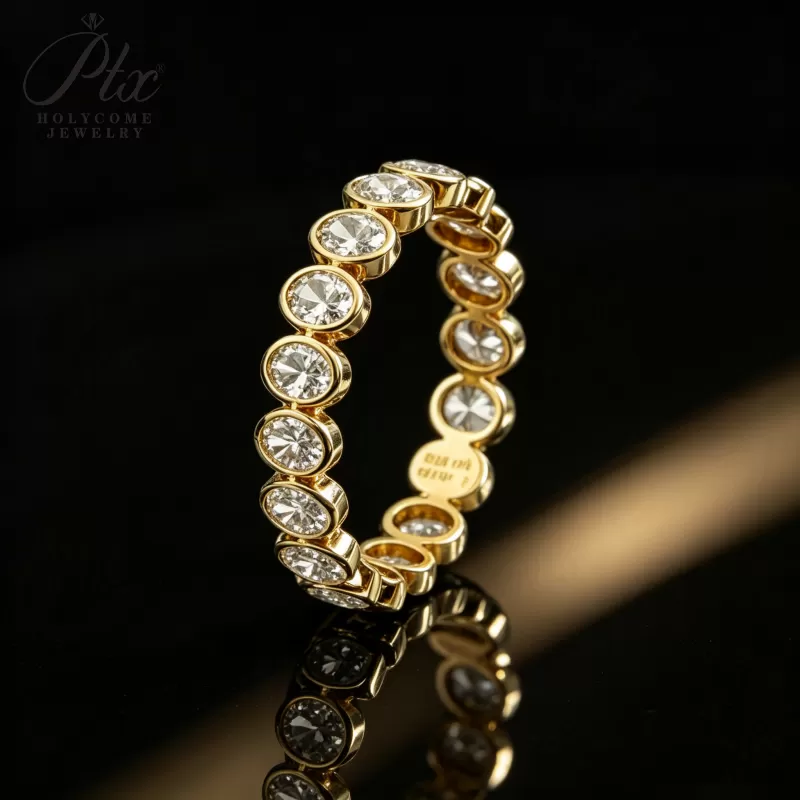
Tennis bracelets are the silent profit center of a jewelry case. A well-made 3 mm moissanite line bracelet retails for more than most pendants, reorders faster than most rings, and photographs beautifully on model wrists for social content. They are also the category where a bad setting shows up fastest: one loose stone, a weak clasp or a chain that kinks at the wrist and the whole piece comes back. Wholesale buyers who spec a tennis bracelet order by stone count, karat and clasp on the PO avoid 90 percent of those returns.
What tennis bracelet means at wholesale
A tennis bracelet is a continuous line of matched stones set in a flexible metal chain, popularized after Chris Evert dropped a diamond bracelet during a US Open match. The diamond reference on Wikipedia covers the 4Cs that historically priced these pieces; at the moissanite wholesale tier, buyers instead price by total stone count, stone diameter and metal karat. A 3 mm stone is roughly 0.10 carat equivalent; a 4 mm stone is roughly 0.25 carat equivalent. A standard 7 inch women bracelet carries 22 to 25 stones at 3 mm, or 15 to 18 stones at 4 mm.
Stone count and total carat equivalent
Buyers should plan the bracelet by total visual carat rather than by individual stone. A 3 mm moissanite tennis bracelet across 23 stones reads as roughly 2.3 carats total equivalent and retails in the bridge tier. A 4 mm bracelet across 17 stones reads as roughly 4.2 carats and sits in the heirloom tier. A 5 mm bracelet, which is a statement piece, carries 12 to 14 stones and retails at the top of the case. Most boutiques move 3 and 4 mm pieces as the volume SKUs; 5 mm moves as a bridal and anniversary special-order.
Setting: prong versus channel versus bezel
Four-prong settings are the classic look and show the most light through the stone, but prongs catch on sleeves and gloves over time. Channel settings, where stones sit in a metal track, are the most durable for daily wear and suit buyers who want the bracelet to survive typing, cooking and childcare. Bezel settings, with a rim around each stone, read modern and architectural and sell to buyers who already own bezel rings. Wholesale buyers should carry all three in the 3 mm size, because the setting is the choice the customer makes after she has decided on stone size.
Karat options: 925 silver, 10K, 14K
A 925 sterling silver tennis bracelet with rhodium plating is the entry retail tier, usually priced to move at the $180 to $320 retail band. A 10K gold bracelet steps the metal cost up modestly and adds yellow-gold warmth that the silver tier cannot match. A 14K gold bracelet is the bridal and anniversary tier, and carries the metal weight that justifies a heirloom-style retail price. Platinum is rarely used on tennis bracelets at wholesale because the metal cost outruns the retail the category supports. For more on how to position silver versus gold at retail, see K gold versus silver moissanite jewelry for retailers.
Clasp security is non-negotiable
A tennis bracelet without a safety catch is a lost tennis bracelet. Specify a box clasp with a figure-eight safety, or a lobster claw with a secondary ring, on every bracelet over 3 mm. The clasp should be soldered closed, not crimped. Ask the supplier for a photo of the clasp closed and open on the sample; a clasp that looks thin in the photo will fail in the field. For a wider view on how production lead times affect bulk orders, see bulk jewelry order lead times from order to delivery.
Wrist sizing and extender chains
Most women tennis bracelets are produced at 7 inches. Buyers should also stock one 6.5 inch size for petite wrists and a 7.5 inch size for larger builds. A two-inch extender chain soldered onto the clasp covers the range without holding three SKUs. Confirm the extender is made from the same metal and plating as the bracelet, because a mismatched extender is the first thing a customer notices in a mirror.
Frequently asked questions
How many stones are on a standard tennis bracelet?
About 23 stones at 3 mm, 17 stones at 4 mm, or 13 stones at 5 mm on a 7 inch wrist.
What setting is most durable for daily wear?
Channel settings outlast prong settings for daily wear, because there are no exposed points to catch on fabric or glove.
Should I stock 925 silver or 14K gold tennis bracelets first?
Start with 925 silver rhodium-plated at the volume tier, and add 14K gold once you have sell-through data on the silver SKUs.
What clasp should I specify?
A box clasp with a figure-eight safety, soldered closed. Avoid spring rings on pieces over 3 mm.
We manufacture moissanite tennis bracelets in 3, 4 and 5 mm across prong, channel and bezel settings, in 925 silver rhodium, 10K and 14K gold. Each ships with a GRA certificate card and a box clasp with figure-eight safety. Send us your wrist size split and your target retail band and we will quote a tiered price list with mixed settings in one order. Pair with moissanite necklaces and lab-grown diamond pieces with IGI papers for a complete bridal wall.