Moissanite Rings Wholesale Price Tiers
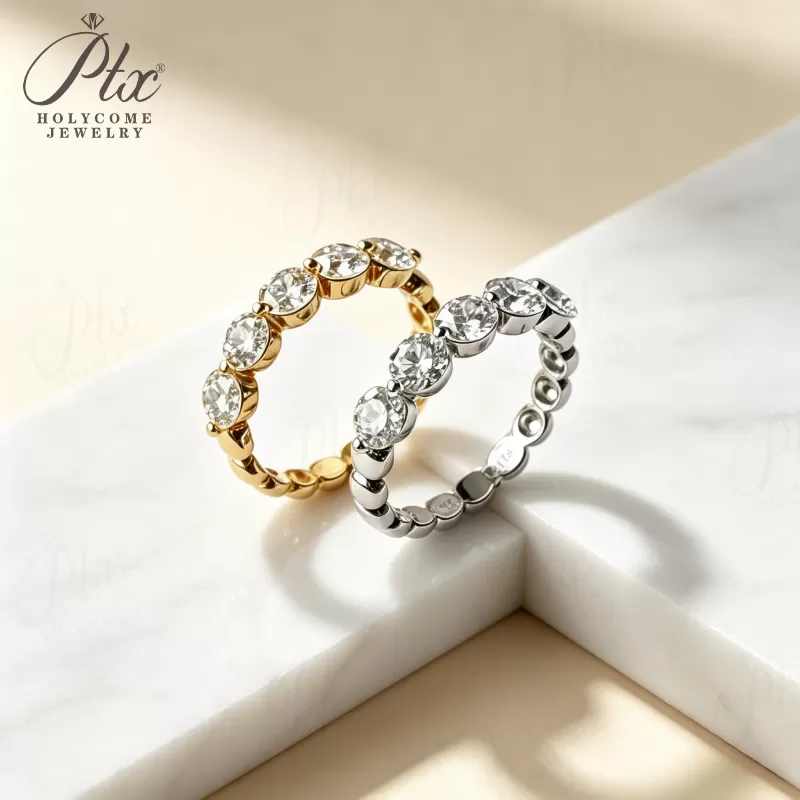
You open three supplier quotes for the same-looking 6.5 mm round moissanite solitaire and the prices differ by almost 60 percent. One quote says 4.80 USD, another 7.20 USD, a third 11.50 USD. The stone looks identical in the photo. If you buy on price alone, you will discover in two months that the cheapest ring tarnished, the center stone tilted, and the card does not match the stone. Wholesale moissanite rings do not sell at one price point. They sit in three tiers, and knowing what you are paying for inside each tier is the difference between a store that reorders and a store stuck with dead stock.
Tier one: the entry-level volume ring
Tier one is the 4.50 to 6.50 USD FOB solitaire. It uses a 925 sterling silver shank rhodium-plated twice, a machine-cast head, prongs stamped rather than hand-finished, and a GRA card printed in the same workshop that packs the box. The moissanite itself is usually a 5H to 6H color grade, which means it reads slightly grey under cool store lighting. This tier sells in under-25 USD retail price points, mainly to gift shops, Amazon sellers and market stalls turning over large unit volume. The moissanite material is real silicon carbide in all three tiers; what changes is the cut grade, the mounting and the paperwork.
Tier one works, but only if you understand its ceiling. Expect a 2 to 3 percent customer return rate on stone tightness, because mass-cast prongs loosen faster. If you plan to retail above 29 USD, do not build the display around tier one. For the markup math on any solitaire, read our guide to moissanite ring retail markup basics before you commit a full PO.
Tier two: the mid-range bridal tier
Tier two sits at 7.00 to 10.50 USD FOB. The shank is still 925 silver but it is hand-polished, the head is cast and then re-finished, prongs are rounded and burnished, and the rhodium plating is thick enough to survive six months of wear before showing copper tone. The stone is 7H to 8H color, cut to a tighter symmetry so it holds fire under 4000K boutique lighting. A proper GRA grading card and a stone laser-inscribed with a matching number are included. This is the tier that boutiques in the US, UK and Australia actually reorder, because it retails between 59 and 99 USD and photographs well.
The GIA 4Cs framework matters most here. Color and cut grade on a mid-tier moissanite decide whether your customer thinks it looks like a 1-carat diamond or a cubic zirconia. Do not accept a tier-two quote without asking the factory for a lightbox video of the exact stone lot, because color consistency across a 50-piece run is where lazy suppliers cut corners. Pair the solitaire with a matched band using our moissanite wedding band width grid.
Tier three: the premium white-metal tier
Tier three is 12.00 USD and up, and it splits into two products. One is a silver solitaire with an 8H to 9H D-color stone, platinum-grade rhodium and hand-set micro-pavé side stones, retailed at 129 to 199 USD. The other is the 10K or 14K gold mount, where the gold weight alone pushes FOB over 35 USD. These stones ship with a paired GRA report and often an NGTC check for the Chinese domestic market. The premium tier is where your store earns its reputation, but it should not exceed 20 percent of a first order, because it moves slower than tier two.
If you are choosing between gold tiers on the same stone, our k-gold karat choices by market guide explains which karat sells where. For ring size planning inside any tier, see wholesale ring size distribution.
Why is the same 6.5 mm moissanite priced so differently?
The stone rough is cheap, but the cut, the mounting, the plating thickness and the certificate are where the cost lives. A hand-cut 6.5 mm 8H stone can cost four times a machine-cut 5H stone of the same size, even though the carat weight matches.
Which tier should a new retailer stock first?
Start 60 percent in tier two, 30 percent in tier one and 10 percent in tier three. Tier one feeds foot traffic, tier two builds margin, tier three builds trust. Flipping that ratio ties up cash in pieces that take a year to sell.
Does a cheaper GRA card mean the stone is fake?
No. Moissanite is moissanite regardless of the card. A loose card simply means you have less proof to show a skeptical customer, which matters once you sell above 49 USD retail. Always ask whether the laser inscription number matches the card.
How much should I budget for a 200-piece starter ring order?
At a blended 8.50 USD FOB and 250 USD international freight, plan around 1,950 USD landed for 200 solitaires, before packaging and duties. Confirm Incoterms with your supplier before paying.
Ready to price your own ring mix? HOLYCOME quotes tier-one, tier-two and tier-three moissanite solitaires side by side, with stone videos and matching GRA cards. Send your target retail price and your market, and we will build a tiered mix that protects your margin on the next reorder.
Frequently Asked Questions
Is moissanite a good diamond alternative for retail buyers?
Yes for price-sensitive customers who want brilliance and hardness. Moissanite ranks 9.25 on the Mohs scale, holds up to daily wear and costs a fraction of a natural diamond of the same size, so it resells fast in bridal and fashion lines.
What is the minimum order for wholesale moissanite?
MOQ starts at 50 pieces per design for stock items. Custom cuts and private-label settings usually start at 100–300 pieces depending on the mold.
Do you provide certificates with moissanite stones?
Yes. Every parcel ships with GRA or IGI documentation listing carat weight, color grade and cut. We recommend passing the certificate to your end customer for trust.
How long does sample and bulk production take?
Samples ship in 3–5 days. Bulk runs take 15–20 days under 500 pieces, and 25–30 days for custom work.