Earring Size and Gauge Guide: Hoops, Studs, and Dimensions
Rings get all the sizing attention, but earrings have their own sizing language, and getting it wrong is just as frustrating. Hoops come in diameters that mean nothing to a new buyer, studs are described by carat you cannot see, and pierced ears are measured in gauge that sounds like engineering. A hoop that looked elegant online arrives as a huge statement ring on the ear, or a stud that looked substantial turns out tiny. Earring sizing is really about three things: the diameter of hoops, the size of studs, and the gauge of the post for pierced ears. Once you understand those, choosing earrings that flatter the face becomes straightforward.
This guide explains earring sizes in plain terms, how hoop diameter relates to face shape, what stud sizes actually look like on the ear, how gauge works for pierced ears, and what wholesale buyers should stock to fit most customers. If you want the short version: measure hoop diameter against your face, start studs around 6 to 8mm for everyday wear, and standard pierced ears take a 0.8 to 1mm post. The rest of this article walks through each measurement so you order earrings that look right the first time.
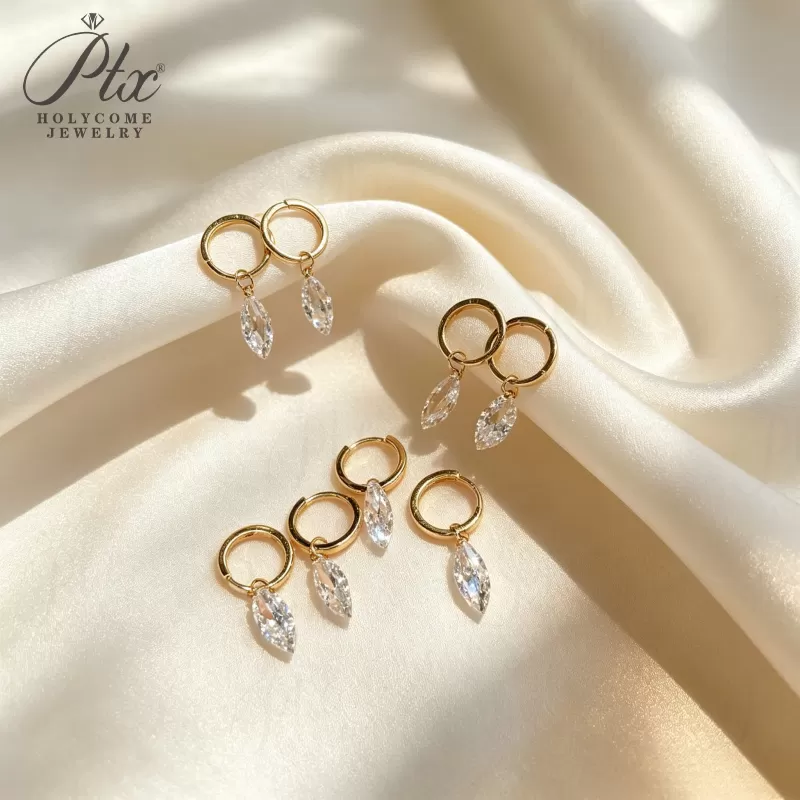
Hoop Diameter: What the Numbers Mean
Hoops are measured by their diameter, the distance across the circle, usually in millimeters. A 10mm hoop is small and hug the earlobe, close to the skin. A 30mm hoop is a medium swing that frames the jaw. A 50mm hoop is a large statement that reaches the chin. The jump between sizes is visual and dramatic, so a 20mm hoop looks very different from a 40mm one, even though the numbers sound close. Always check the millimeter measurement, not just the word small or large, because retailers label hoops inconsistently.
To picture a hoop before buying, hold a ruler to your earlobe. A hoop that ends around the middle of the earlobe is a small everyday size, roughly 20 to 30mm. Hoops that reach the jawline are 40mm and up. People often underestimate hoop size, because a 40mm hoop sounds modest but swings noticeably on the ear. When in doubt, choose the smaller diameter for everyday wear, because oversized hoops are harder to pull off daily and catch on hair and clothes.
Hoop Thickness and Weight
Beyond diameter, hoops have a thickness, the width of the metal tube itself. A thin 1mm hoop is delicate and light, while a 5mm thick hoop is bold and heavy. Thickness changes the look as much as diameter. A large thin hoop is airy and modern, while a small thick hoop is chunky and retro. For everyday comfort, thinner hoops are easier to wear all day, because heavy thick hoops pull on the lobe and can stretch the piercing over time.
Weight matters for comfort. Heavy hoops, especially large ones, pull the earlobe down and can stretch the piercing hole, which is uncomfortable and hard to reverse. If you want large hoops, choose a hollow or thin-tube construction that looks big but is light. We see customers buy heavy statement hoops and then not wear them because they hurt after an hour. Lightweight large hoops are the compromise that works.
Stud Sizes: What Carat Means on the Ear
Stud earrings are described by the stone size, often in millimeters or carats. A 4mm stud is tiny, a subtle sparkle close to the ear. A 6 to 8mm stud is the classic everyday size, visible but not loud. A 10mm and up stud is a statement, suited to evening wear. Moissanite studs are often sold by carat total weight, where a one-carat pair means half a carat per ear. Understanding the millimeter size is more useful than the carat, because it tells you how the stud will actually look.
For everyday wear, a 6 to 8mm moissanite stud is the sweet spot. It is bright enough to catch light, small enough to wear to work, and it suits most face sizes. Larger 10mm studs are beautiful but read as dressy. We explain the stone side in our carat sizing guide, but for studs the rule is to start modest and go bigger for occasion wear. Customers who start with huge studs often find them impractical, while those who start at 6mm wear them daily.
Earring Gauge: The Post Thickness
Gauge is the thickness of the earring post, and it matters for pierced ears. Standard pierced ears heal to about a 20 gauge, roughly 0.8mm, which fits most everyday studs and thin hoops. If you wear thicker posts or tunnels, your ear is stretched to a larger gauge. Most people with standard piercings should stick to 0.8 to 1mm posts, because a post that is too thick is painful and can stretch the piercing uncomfortably. We discuss sensitive ears and posts in our sensitive skin guide, and post thickness is part of that comfort.
For new piercings, always use the post thickness the piercer recommends, usually a thin hypoallergenic stud, and do not switch to thick hoops until the piercing is fully healed. Putting a heavy hoop into a fresh piercing causes irritation and healing problems. Once healed, standard gauge posts fit comfortably. If a customer complains that a hoop hurts, the post is often too thick for their piercing, and switching to a thinner gauge solves it.
Face Shape and Hoop Choice
The size of hoop that flatters you depends on your face. Long, narrow faces suit wider, medium hoops that add width around the jaw. Round faces suit longer, drop-style hoops that elongate. Smaller faces suit smaller hoops, because oversized hoops overwhelm delicate features. This is a styling guide rather than a rule, but it helps customers choose a diameter that balances their face rather than one that fights it.
For wholesale buyers, stocking a range of diameters covers all face shapes. A small huggie, a medium everyday hoop, and a larger statement hoop in the same metal gives customers options. We supply hoops in a range of diameters and thicknesses, and we recommend retailers display them on a bust so customers can see the scale on a face, because a hoop on a flat card looks very different from a hoop on an ear.
Backs, Closures, and Security
Earrings come in several closure types, and the closure affects both comfort and security, which is part of sizing. Butterfly backs, the standard friction backs on studs, are light but can slip off, which is why people lose expensive studs. Screw backs tighten into place and are far more secure, ideal for studs you never want to lose, though they take a moment to fasten. Hinged hoop clasps open and click shut, and they are secure for hoops but should be checked because a worn hinge can open. When you choose earrings, match the closure to how much you worry about losing them.
For active wear or travel, secure backs matter. A stud with a friction back can fall out during exercise, sleep, or while brushing hair, and people notice months later that one earring is gone. We recommend screw backs or locking backs for valuable moissanite studs, because the small convenience of a friction back is not worth losing the stone. For hoops, a well-made click closure stays shut, but cheap hinges pop open easily, which is another reason to buy decent quality. We discuss this in our care notes, but security is really a sizing and choice decision at purchase.
Oversized or heavy earrings benefit from a support back that distributes weight over a larger area of the lobe, reducing the pull. These are useful if you love large statement earrings but find them uncomfortable. They turn a heavy earring into a wearable one, and they also prevent the lobe from stretching over time. If a customer loves a big hoop but complains it pulls, a support back is the fix rather than downsizing.
Drop Earrings and Length
Drop and dangle earrings are measured by their length from the piercing, not their width. A short drop of 20mm sits just below the lobe, a medium drop of 40mm frames the cheek, and a long drop of 60mm and up reaches the jaw or neck. Length changes the look dramatically, and it is the measurement to watch for drops. A long drop elongates the face and draws the eye downward, which can be elegant but also reads as formal. Short drops are more everyday.
Long drops catch more on hair, necklines, and collars, which is a practical consideration. A very long dangle can tangle with necklaces, as our necklace length guide discusses, because the two layers interact. For work or active days, shorter drops or studs are simpler. For evenings and events, longer drops shine. Choosing the length is really choosing how formal and how much movement you want.
For wholesale buyers, carrying a range of drop lengths covers both daily and occasion wear. A short huggie, a medium drop, and a long statement drop in the same moissanite style lets customers build a coordinated earring wardrobe. We supply all three lengths, and retailers who display them on a bust help customers visualize the scale, which is the hardest part of buying earrings online.
Sizing for Multiple Piercings
Many people now have multiple ear piercings, and each piercing is sized for a different earring. Lobe piercings take standard gauge studs and hoops, while cartilage piercings in the upper ear often need shorter posts and smaller diameters, because the ear curves. A long stud meant for the lobe will not sit right in a cartilage piercing, and a large hoop will not fit the small curve of a helix. When buying for multiple piercings, choose earrings designed for that specific spot.
Stacking earrings across piercings is a styling choice, and size matters so the pieces do not fight. A small stud in the upper ear, a medium hoop in the middle, and a larger hoop or drop on the lobe creates a graduated look that balances. Putting a huge hoop on every piercing overwhelms the ear. This is really about proportion, and the same diameter rules apply: smaller pieces higher up, larger pieces lower on the lobe.
For retailers, stocking a mixed range of small studs, huggies, and medium hoops serves customers who are building a stacked ear. These customers buy several pieces at once, which is great for basket size. We supply mixed earring sets for exactly this, and we advise on which sizes suit which piercings. The earring buyer is often a repeat buyer, because once someone has multiple piercings, they keep adding to them.
Metal and Comfort in Earrings
Earring comfort is as much about the metal as the size, because the post goes through a piercing that is sensitive. Sterling silver posts are a good choice for most people, but pure silver is soft and posts can bend, so they need to be handled gently. Rhodium-plated silver posts are smooth and white, which many prefer. For sensitive ears, the post metal matters more than the hoop itself, and we explain the hypoallergenic side in our hypoallergenic earrings guide. A pretty hoop with a post that irritates is a pair you will stop wearing.
Heavy earrings in soft silver can also bend out of shape if dropped, which affects how the post sits. Choosing well-made, properly supported earrings means the post stays straight and the earring sits flush. Cheap earrings with thin posts often tilt and sit at an awkward angle, which is not a size problem but a quality one. When customers complain that earrings sit crookedly, the cause is usually a bent or poorly soldered post, not the size they chose.
Ordering Earrings Online Without Trying Them
Buying earrings online is common, and the size is the main risk. Because you cannot hold a hoop to your ear, the millimeter measurement is everything. Check the product photos for scale, ideally a photo of the earring worn on an ear, because a hoop on a white background can look any size. If the listing only says small or medium without millimeters, ask the seller. A reputable supplier gives exact dimensions, and you can then compare them to a ruler held to your ear.
For studs, look for the millimeter stone size, and remember that a pair listed as one carat total is half a carat per ear. When in doubt, order the smaller size for everyday wear, because earrings that are slightly understated always work, while earrings that are too big can feel costume-y. We include exact dimensions and worn-on-ear photos with our wholesale earrings, because we know sizing is the top reason for online returns. Getting the size in the description prevents most of them.
Building an Earring Wardrobe by Size
The smartest way to buy earrings is to build a wardrobe across sizes rather than buying pairs all the same. Start with everyday studs around 6mm, which go with anything and never feel overdressed. Add a small hoop, 20 to 30mm, for a step up in style. Then a medium drop or a larger hoop for occasions. With these three sizes, you cover every outfit and moment, and each piece complements the others. People who buy only big statement earrings find they have nothing to wear to the office, while people who buy only tiny studs find nothing for evenings.
Moissanite works especially well across this range, because a small moissanite stud has real sparkle, unlike a tiny cubic zirconia that looks dull. A 6mm moissanite stud catches light even at its modest size, which is why it is our best-selling earring. Customers who start with moissanite studs often come back for matching hoops and drops, because the stone quality is consistent across the range. We discuss the stone quality side in our clarity guide, but for a wardrobe, the point is that one stone style in three sizes covers most needs.
For wholesale buyers, this wardrobe logic is how you merchandise. Display a stud, a hoop, and a drop together so customers see they are a set, not separate purchases. The average basket rises when customers build a coordinated look. We supply these coordinated ranges, and we advise retailers on the size mix that sells best. The earring customer who buys one stud often leaves with three, once they see how the sizes layer.
Caring for Earrings Once You Have the Right Size
Once your earrings fit and flatter, a little care keeps them looking right. Clean moissanite studs and hoops regularly, because ear oils and wax build up behind the stone and dull the sparkle. We walk through the method in our care guide, but for earrings the key is to clean behind the setting, where oil collects. Store each pair in its own pouch so hoops do not scratch each other or tangle with necklaces. And check the backs and hinges now and then, because a worn clasp is how people lose a favorite pair.
Silver earrings tarnish like all silver, and that is normal, not a reason to think the pair is poor quality. A polishing cloth brings the shine back. When customers complain that their earrings looked brighter in the box, the answer is almost always a quick clean, not a defect. We supply care notes with our wholesale earrings so customers know this up front, which prevents returns that are really just cleaning needs. A well-cared-for pair of moissanite earrings stays bright for years, and the right size keeps them comfortable on the ear every single day. That is the whole simple goal: earrings you forget you are wearing because they simply fit and shine, day after day, without pulling, pinching, or catching on anything.
Frequently Asked Questions
What hoop size is best for everyday wear? A small to medium hoop, around 20 to 30mm in diameter, is the most versatile daily size. Larger hoops are better for statement looks.
What size moissanite stud should I buy? A 6 to 8mm stud is the classic everyday size. Start there, and go larger for dressier pairs.
What gauge is a standard ear piercing? About 20 gauge, around 0.8mm. Most everyday studs and thin hoops fit this. Use thicker posts only if your piercing is stretched.
Do heavy hoops damage earlobes? Over time, heavy hoops stretch the piercing and pull the lobe. Choose lightweight large hoops for comfort.
Choose Earrings That Fit the Ear
Earring sizing is about diameter, thickness, and gauge, and once you know those, choosing earrings that flatter is easy. Measure hoop size against your face, start studs at a comfortable everyday size, and match the post gauge to your piercing. Done right, the earrings you order online look exactly as you hoped when they arrive.
If you need wholesale earrings in a range of sizes and gauges, we are a moissanite and 925 silver manufacturer in Wuzhou, China. Contact service@holycome.com, and see our other size guide articles for rings, bracelets, and necklaces. We are here to help you choose the perfect earrings for every occasion, with honest sizing advice and wholesale pricing that makes building your collection easy, simple, and truly affordable.
The last thing to remember is that earring size is reversible and forgiving in a way ring size is not. If a hoop arrives larger than you pictured, it still works as a statement pair; if a stud is smaller than expected, it becomes a subtle everyday pair. Unlike a ring that either fits or does not, earrings are flexible, and most size surprises still look good. The main things to avoid are a post gauge that does not fit your piercing, and an earring so heavy it pulls. Get those two right, and the rest is personal taste. Buy the millimeter sizes, check the worn photos, and build a few pairs across the range, and you will have earrings for every occasion without a single regret.